
 Netherlands
- EN
Netherlands
Netherlands
- EN
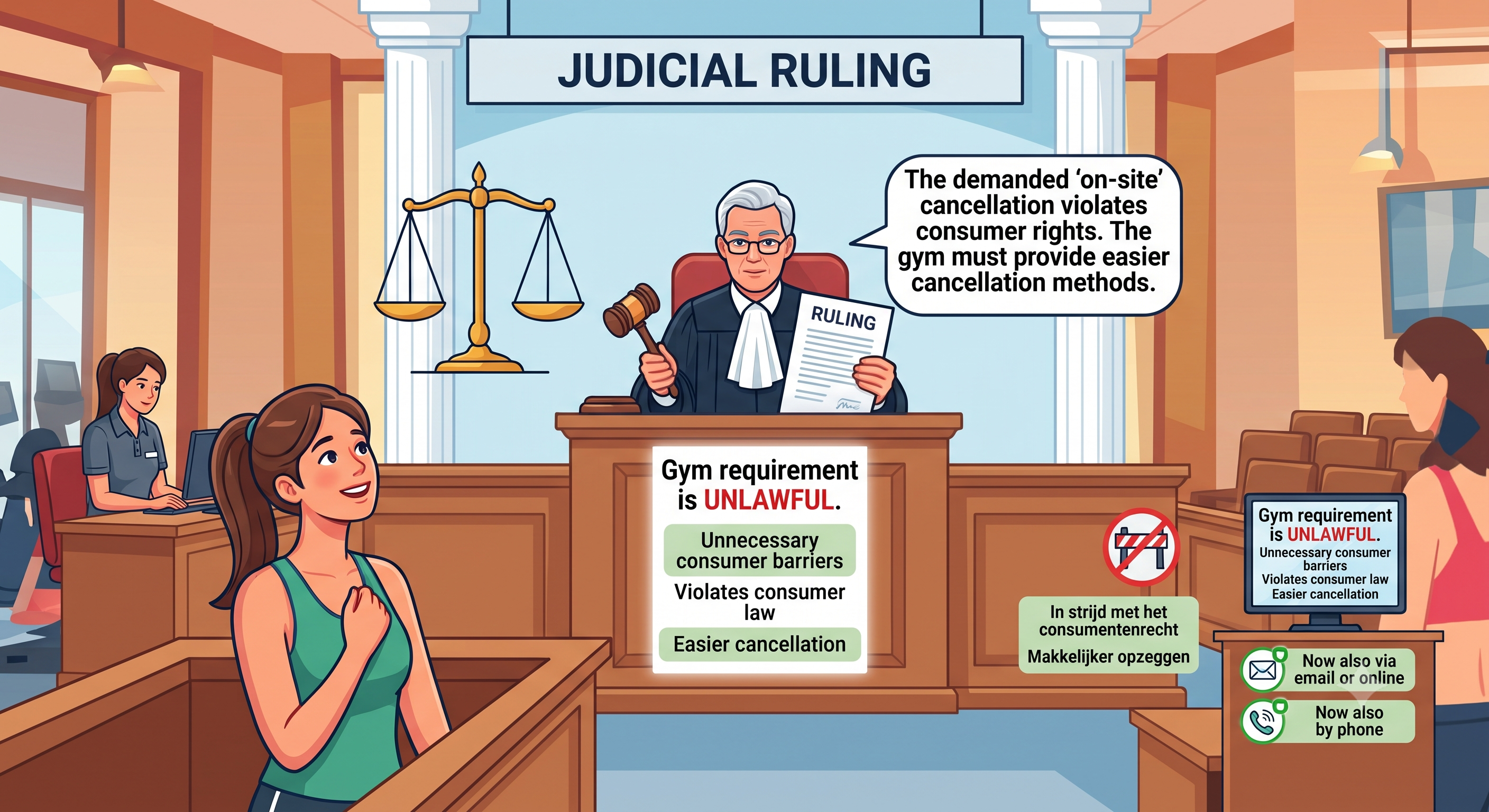
What the judge ruled
On 23 July 2026, the district court (kantonrechter) in Enschede heard the case of a member against the gym ClubFit on the Parkweg. ClubFit demanded that members cancel their membership in person at the desk — a letter, email or remote form did not count. The member thought that was nonsense and went to court.
The ruling was clear: a gym may not require you to turn up in person at the desk to cancel. A condition like that makes cancelling needlessly difficult, and that is exactly what the law does not allow.
Why "at the desk only" doesn't hold up in law
This is not a new position — it is firmly rooted in Dutch consumer law. A company is allowed to set out in its terms and conditions how you cancel, but it may not put more obstacles in your way than are strictly necessary. The moment a clause requires you to cancel in a "stricter form" than an ordinary written notice — such as compulsory attendance in person — the law presumes that clause to be unreasonably onerous. This sits on the so-called grey list (Article 6:237 of the Dutch Civil Code). The company then has to prove that the requirement is in fact reasonable, and that almost never succeeds.
The Amsterdam district court reasoned in exactly the same way back in 2013: a gym that insisted on cancellation "in writing at the desk" came off worst (ECLI:NL:RBAMS:2013:BZ6804). This week's Enschede ruling therefore stands in a long line. Being able to cancel only at the desk is, and remains, unreasonably onerous.
We already won this exact fight — in Belgium
For us, this is not theory. We have already fought this battle in court ourselves, and won.
In Belgium, NRG Fitness (now JIMS) refused the cancellation letters that customers sent through our service (opzeggen.be). Their reasoning: cancellation could be done "exclusively on site at the branch". We did not let it rest and brought a case (case number A-20-2463).
The court swept the condition aside. The requirement that you could only cancel at the branch was labelled an unfair term in a consumer contract and declared void (under the European Unfair Terms Directive 93/13/EEC). Refusing our cancellation letters also counted as an unfair market practice, and the condition unlawfully restricted customers' right to prove that they had cancelled. The result: a €500 fine for every cancellation letter the chain would go on to refuse — and that fine has unfortunately been paid several times, because things kept going wrong afterwards.
The message from Belgium and the Netherlands is the same. An organisation may not make cancelling needlessly complicated, and it cannot simply brush aside a valid written cancellation.
What this means for you
In short: don't let them send you to the desk. Told that cancelling is only possible in person? You are on firm legal ground if you simply cancel in writing. And the best possible proof that you cancelled on time and correctly is a registered cancellation with a date that cannot be disputed.
That is exactly what we arrange for you. Through Opzeggen.nl we send your cancellation by registered post, with legally watertight proof of receipt, straight to the right department. You supply a few details, we do the rest — and if the organisation later claims they "never received anything", that registered delivery means there is simply proof. Cancelling really should always be this easy. That we occasionally need a judge to make it so shows we are not quite there yet in the Netherlands.